Sustainable safari tourism is about more than green claims and impressive promises. Experts in the field explain how to check operational proof, ownership records, dated data, and quantified impact reports. Rwanda’s community revenue model also shows how tourism can deliver clear benefits to local people.
- Follow Rwanda’s Community Revenue Model
- Demand Measurable Operational Proof
- Trace Ownership and Dated Data
- Request Quantified Impact Reports
1. Follow Rwanda’s Community Revenue Model
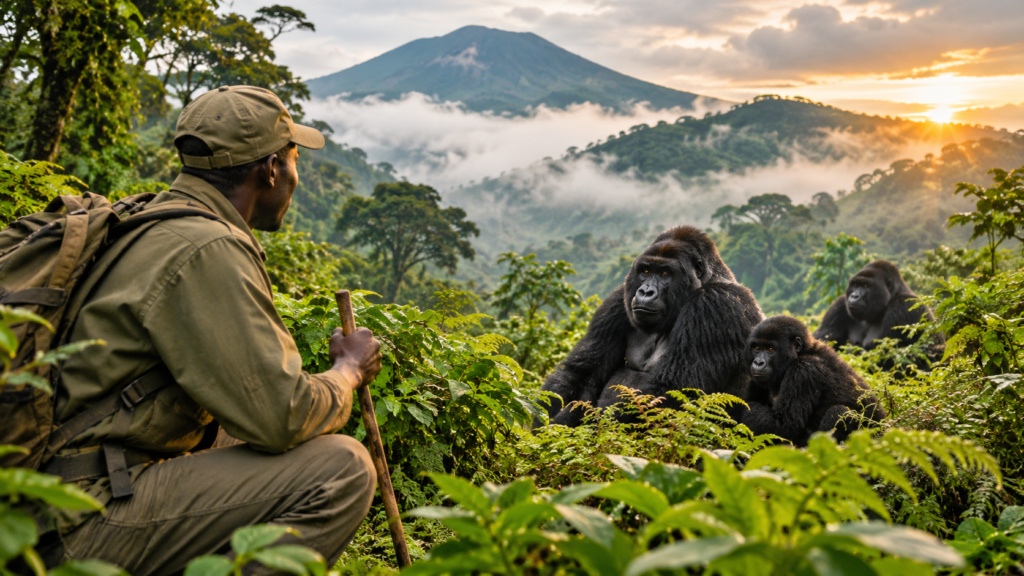
Sustainable safari tourism is not a label. It is where the money goes and who decides. In Rwanda, the clearest example is the Tourism Revenue Sharing Programme: 10% of national park tourism revenue is reinvested in communities living around the parks. More than Rwf 23 billion has gone into about 1,300 community projects this way, including schools, health centres, clean water and livestock. Communities that once saw parks as lost farmland now see gorillas as their neighbours’ livelihood, and many former poachers have become protectors.
Rwanda’s high-value, low-volume model, with limited daily gorilla permits at a premium price, shows that luxury and sustainability can work together. Fewer visitors paying more means less pressure on the forest and more money for conservation. The trade-offs are real: it limits access for budget travellers, and park expansion requires resettling families, which must be done fairly and transparently.
How travellers can spot greenwashing:
- Ask who guides you. Local, licensed guides from the community, paid fairly, are the strongest sign that money stays local.
- Ask for numbers, not adjectives. How many local staff? What share of spending goes to community projects? A genuine operator answers without hesitating.
- Check group sizes and wildlife rules. Responsible operators respect visit limits, distances and time with animals, even when guests want more.
- Look for community ownership, not just donations. Cultural experiences run by the community itself, such as villages run by former poachers near Volcanoes National Park, matter more than a cheque handed over for photos.
- Watch for single-use plastic. Rwanda banned plastic bags in 2008. If an operator ignores small rules, they likely ignore big ones.
Enock Musabyimana, Senior Safari Guide, Huza Gateway Safaris
 Enock Musabyimana
2. Demand Measurable Operational Proof
Sustainable safari tourism in Africa should be measured by how well a business protects wildlife, supports local communities, and manages resources, not by how many environmental claims appear on its website. From my work in hospitality and sustainable product distribution, I’ve learned that responsible operations require practical decisions, particularly around purchasing, waste reduction, and long-term supplier relationships. For example, when working with cafes to introduce reusable coffee cups, I’ve seen how important it is to consider the entire operating system, including cleaning, durability, and replacement costs, rather than simply swapping one product for another. Safari lodges should apply the same thinking by tracking water consumption per guest night, reducing single-use packaging, managing wastewater, and purchasing from locally owned businesses. Luxury safaris can be sustainable, but operators must acknowledge trade-offs such as air travel, energy-intensive amenities, and water use rather than assuming solar panels offset every environmental impact. I would encourage travelers to ask for independently verified conservation contributions, the percentage of employees hired locally, community revenue-sharing arrangements, and documented waste and water management results. Genuine sustainability means showing measurable improvements over time, while greenwashing relies on attractive promises without the operational evidence to support them.
 David Karmiryan
3. Trace Ownership and Dated Data
- Track claims to more than one source’s lodge information. Before I travelled to Namibia I searched for the names of all the lodges and their respective conservancies. Of the many claims from the various lodges and their communities, only that of one conservancy had the community describe the lodge in positive terms. Greenwashing travels in one direction: lots of words that no one else verifies.
- Ownership beats donations. In the communal conservancies of Namibia, the community owns the land on which the lodge is based and the lodge then pays the community a share of the revenue generated by the lodge. As such, the community can withdraw from the partnership at any time should they feel that things are not going well enough. So ask who owns the land and who can cancel the contract.
- The guide. Our guide in Tanzania would regularly switch off the engine of our vehicle and then sit in silence for what seemed like an age, waiting for a leopard to appear. He was excellent at explaining why he was doing things in a particular way and I believe that the way that operators train and pay their local guides is key to having good wildlife views and calm animals. After that I would like to see details of water, energy and waste usage at a lodge.
- Yes. If you consider space and quiet to be luxury then yes, Botswana’s low-volume, high-cost tourism model works well. But you have to be willing to refuse guests who expect a hot tub and want to be entertained in the middle of nowhere. A bucket of warm water over a basin and a great guide is all you need.
- Ask for a single number and the date on which it was last checked for each of the following: community payments, percentage of staff from local villages, litres of water per guest night. One dated number is far better than ten vague logos. This comes from a handful of trips and lodges so take with a pinch of salt. – Small sample.
 Daniel Goh
4. Request Quantified Impact Reports
I’m answering as a travel advisor who books safari lodges for private clients, so my angle is how to tell the difference before you pay.
Greenwashing talks about values; genuine operators publish numbers. Before we recommend a lodge, we ask for its latest impact report and look for:
– How much reaches the community per guest night, and through what: a conservancy lease paid to landowners or a bed-night levy is easier to verify than “we support a local school”.
– The share of staff, and of managers, hired locally.
– How much land the business protects, how that’s funded, and its limit on vehicles at a sighting.
– Energy and water use per guest night, and the share of power from solar.
– Independent certification, such as Fair Trade Tourism in South Africa or Ecotourism Kenya’s eco-rating, rather than self-awarded labels.
If a lodge can’t answer in figures, that tells you most of what you need to know.
Can luxury safari be sustainable? Yes, because the high-value, low-volume model lets fewer guests fund more protected land: a small camp on a private conservancy can do more per visitor than a high-volume lodge. The trade-offs are real, though: light-aircraft transfers, plunge pools in dry country, imported food and wine. The honest operators name them and show what they’re doing about each.
For travellers, the simplest test is one question before booking: “What would change in this area if your camp closed tomorrow?” The good ones have a precise answer.
 Marina Vlasenko
What This Means for Travelers
Across four different voices, the same ideas kept coming back. For anyone planning a high-end safari, four takeaways stand out:
Follow the money and the ownership. Sustainability is where the money goes and who decides. Ask what share of revenue reaches the community, who owns the land, and who can end the partnership if it isn’t working. Ownership beats donations.
Ask for numbers, and ask for the date. Staff hired locally, community payments, and water and energy use per guest night should each come with a figure and a “last checked” date. If an operator can’t answer in figures, that tells you most of what you need to know.
Prefer independent proof to self-awarded labels. Third-party certifications, published impact reports and verified conservation contributions carry more weight than a logo on a website. Cross-check an operator’s claims against what the surrounding community says.
Look for honesty about trade-offs. Light-aircraft transfers, plunge pools in dry country and imported food all have a footprint. The best operators name these costs and show what they are doing about them. A good operator can also tell you what would change in the area if their camp closed tomorrow.
The common thread is evidence. Genuine sustainability can be shown, dated and checked by someone other than the operator, and greenwashing cannot.
 Compiled by

